


A Policy on Restraint and Seclusion Is Needed — But Ontario Also Needs to Ask Why Students Are Reaching Crisis

Updated: 3 days ago
Note: This article accompanies our media statement that can be read here.
Community Living Ontario's September 2026 policy brief, “Restraint and Seclusion are Harmful and Ineffective” calls on the Ontario Ministry of Education to establish provincial guidance to limit and ultimately end the use of restraint and involuntary seclusion in schools.
This is an important call.
Ontario needs clear, consistent provincial expectations around restraint and seclusion. Families should not have to navigate substantially different practices depending on their school board or school. Disabled and neurodivergent students should not be subjected to restrictive practices without clear safeguards, accountability and oversight.
But there is another question that needs to be part of this conversation:
What can Ontario do to reduce the circumstances that lead to students being pushed into crisis in the first place?
A policy governing what happens during a crisis is important.
But it is not the same thing as designing schools so that fewer students reach that point.
We need both downstream safeguards and upstream prevention
CLO's brief appropriately emphasizes prevention, the role of the environment, understanding the causes of behaviour, trauma-informed practice, co-regulation, staff training and access to supports. It also highlights a school-board policy that recognizes the interaction between students and their environments and the importance of environmental stability, opportunities to participate and succeed, relationships and co-regulation.
These are important pieces of the solution.
But they raise a larger question:
Are Ontario schools being designed and staffed in ways that anticipate neurological, sensory, communication and regulation differences—or are accommodations being added only after a student is already struggling?
For an autistic or otherwise neurodivergent student, an environment can become overwhelming for many reasons.
It may involve:
excessive noise or visual stimulation;
unpredictable transitions;
demands that exceed the student's available capacity;
insufficient processing time;
limited access to movement;
communication barriers;
lack of access to AAC or other communication supports;
sensory needs that aren't accommodated;
expectations for prolonged sitting or stillness;
repeated demands when a student is already overwhelmed;
punitive responses to distress;
insufficient opportunities for breaks or recovery.
A student in crisis is in a state of survival, not a state of learning. We cannot teach our way out of a physiological distress response; instead, we must look at how the environment or our expectations can be modified to restore their sense of safety.
Prevention cannot simply mean preventing “challenging behaviour”
CLO recommends a research-based definition of “challenging/risk-of-injury behaviour” that helps staff understand its causes.
That is important.
But there is a subtle distinction worth making.
A neuro-affirming approach does not ask only:
How can we prevent this behaviour?
It also asks:
What is this student experiencing?
What is the environment demanding of them?
What communication might be occurring?
What could we change before the student reaches this level of distress?
And perhaps most importantly:
Is the goal to make the student safer and more supported—or simply easier for adults to manage?
Those questions matter because not every behaviour that adults find disruptive is inherently harmful.
Movement, vocalizations, stimming, leaving an activity, refusing a demand, seeking sensory input, avoiding overwhelming situations or communicating distress can all be meaningful forms of communication or regulation.
That does not mean genuine safety concerns should be ignored.
It means the response should be based on the actual risk and the student's needs, rather than treating non-compliance or difference itself as the problem.
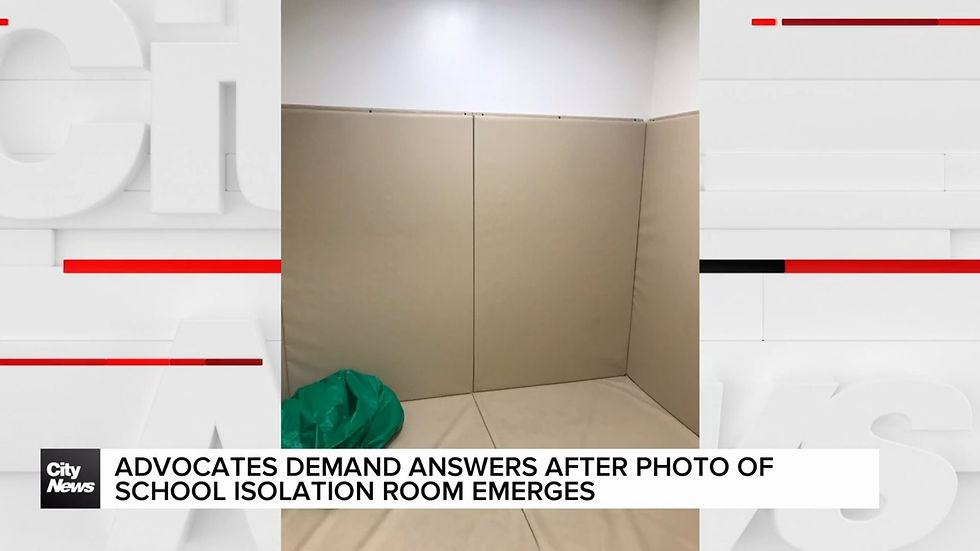
A sensory room should not become seclusion by another name
This distinction deserves particular attention.
A quiet or sensory space can be an important accommodation.
A student may need somewhere to reduce sensory input, recover from an overwhelming experience, use regulation tools or have some time away from classroom demands.
But a supportive regulation space is fundamentally different from involuntary seclusion.
The difference isn't simply what the room looks like.
It is about choice, purpose and the student's ability to leave.
Ontario's K–12 Education Standards Development Committee made this distinction in its recommendations, noting that a calming or sensory room can appropriately be used as a self-regulation strategy but should not be used as punishment or because adequate supports are unavailable.
This is an important principle for any future provincial policy.
A sensory room should support regulation—not become a more acceptable-looking form of isolation.
Staff training needs to go beyond crisis management
CLO appropriately calls for effective training for school staff and identifies trauma, prevention and co-regulation as important elements.
But Ontario should also ask what staff need to understand before a crisis occurs.
Training should help educators understand:
autistic and neurodivergent communication;
sensory differences;
autistic burnout and overload;
the difference between distress and intentional misconduct;
co-regulation;
masking and the potential consequences of prolonged compliance;
movement and stimming as possible forms of regulation;
processing time;
AAC and other communication methods;
environmental accommodations;
proactive regulation supports;
trauma and its interaction with school experiences;
how adult responses can escalate or de-escalate a situation.
This is different from simply teaching staff how to respond when a student becomes unsafe.
Staff need to understand the student before the crisis—not only know what to do during one.
Inclusive design needs to be part of the conversation
There is also a larger issue that cannot be solved through restraint-and-seclusion policy alone.
Ontario's education system often approaches disability through individualized special education processes. That means the student is identified as having needs, and accommodations and supports are then developed around that individual student.
Individualized support is important.
But we should also ask:
What if some of the barriers could be reduced through better design of the school environment itself?
Universal and inclusive design can mean considering from the beginning:
different sensory needs;
different communication methods;
different ways of participating;
movement needs;
quiet spaces;
predictable routines;
flexible ways of demonstrating learning;
opportunities for breaks and recovery;
accessible communication;
different processing speeds.
The goal isn't to design a school specifically for autistic students.
It is to recognize that students are neurologically diverse, just as they are diverse in many other ways.
A school that is more accessible from the beginning may require fewer individual accommodations later—and may reduce the number of situations in which students are pushed beyond their capacity.
Restraint and seclusion should not be viewed in isolation
There is a risk in discussing restraint and seclusion as though they are isolated practices.
They can be part of a much larger pattern.
A student may experience:
sensory overload → distress → escalating demands → adult response focused on compliance → further escalation → crisis → restraint or seclusion.
If policy only addresses the final step, we have not necessarily addressed the conditions that produced the crisis.
We need to examine the entire chain.
What happened earlier that day?
What demands were being placed on the student?
Were communication attempts understood?
Were breaks available?
Were sensory needs accommodated?
Was the student given time to process?
Were staff trained to recognize early signs of overload?
Was the student's IEP being implemented?
Were appropriate supports actually available?
And what happened after the crisis?
These questions are not about blaming individual educators.
They are about recognizing that school systems can either increase or reduce the demands placed on students.
Ontario needs provincial policy—and a broader prevention strategy
The need for provincial guidance is not new.
Ontario's K–12 Education Standards Development Committee previously recommended that the Ministry establish a policy governing seclusion and physical restraints, including criteria for their use, mandatory parent notification and reporting requirements.
CLO's current brief builds on that need and calls for a roadmap toward ending involuntary seclusion and limiting physical restraint to clearly defined emergency situations.
Ontario should act on that call.
But the policy should be part of a broader strategy that addresses why students are reaching crisis in the first place.
That means looking at:
Provincial safeguards and accountability for restraint and seclusion.
Consistent definitions and reporting requirements across school boards.
Meaningful parent/caregiver and student involvement.
Neuro-affirming and trauma-informed staff education.
Environmental and sensory accessibility.
Inclusive design of classrooms and school spaces.
Adequate access to communication, behavioural, occupational therapy, mental health and other appropriate supports.
Proactive regulation and co-regulation supports.
Review of IEP implementation and accommodations when crises occur.
Post-incident review that asks not only what the student did, but what happened around the student.
The goal should not simply be fewer documented incidents of restraint and seclusion.
The goal should be schools where students are more likely to be understood, supported and able to participate without reaching that point.
Restrictive practices are a symptom of a larger problem
Ending involuntary seclusion and reducing restraint are important goals.
But if Ontario wants lasting change, it needs to look beyond the room where the student ends up.
We need to look at the classroom.
The timetable.
The sensory environment.
The expectations.
The communication system.
The student's relationships with adults.
The availability of breaks.
The implementation of accommodations.
The training educators receive.
And the assumptions we make about what behaviour means.
A student should not have to reach crisis before their needs become visible.
Provincial guidance on restraint and seclusion can establish important protections.
But truly inclusive education requires something more ambitious:
designing schools so that a wider range of students can belong, communicate, regulate, learn and participate from the beginning.
That is where prevention begins.
Further reading:
Disclaimer: Please note that the content posted here is provided for general informational purposes only and does not constitute legal or other professional advice on any subject matter whatsoever. Furthermore, all content mentioned is not guaranteed to be accurate, complete, reliable, current or error-free. In using this website, you accept that Balance Support and Self Care Studios will not be held liable for any discrepancies or errors, claims, liabilities, losses, costs, damages or expenses (including attorney's fees) arising from the use of the information contained thereon. The resources, products, and providers listed do not signify endorsement. It is your responsibility to verify any information obtained from this website to your own satisfaction


Comments